A good analogy of HA, unilateral CI and bilateral CI for hearing people

The following words was observed on Facebook (written by my fellow CI-bloggers) this morning.

A CI blog-friend of mine, Valerie, asked for advice on Facebook:

“Our school will have visitors out next week, how do I explain my cochlear implants and deafness without them treating me differently????

Then another CI blog-friend of mine, “the mad dasher”, Sam Spritzer, offered Valerie a very good answer, and I feel compelled to share this with my readers:

Sam Spritzer at 1:17am December 5

If I were you, I wouldn’t even worry about them treating you differently. You can tell them that CIs are the 21st century version of HAs, only better. And if you have to use an analogy, CIs to HAs are like color tv to b&w tvs. And a bi-lateral CIer is HDTV to standard color tv. Good luck!”

This was the best analogy I have seen to date, in order to explain hearing technology to hearing people. Also he is right in saying not to worry about being treated differently. It’s easy to say, of course, but there’s truth in it. I can vouch for that… Think about something else. Avoid or avert those “worry” thoughts…

So, I just want to rewrite the analogy a little bit:

Imagine hearing aids are like Black&White TV. Then CI is like color TV.

If unilateral CI is like color TV, then bilateral CI is like HDTV.

Status update IV – early autumn 2008 – epilogue

You people must become fed up with all these “Status update”-posts, no?
After this rather long and 5-way split Status update, I realized there are some other health issues that needed addressing.

It also serves as a reminder to myself that the purpose of this blog is mainly to be like a medical journal (for myself and others who might need the info).

Status of Tinnitus: rather unchanged.

It is still sounding the same as it did when I started being bothered by it, with a rather constant “UUYYUUUUYYYUUUUYYYUUUUUYYYUUUYYYUU….” around 1 to 1,5 KHz. It’s worst on the right ear, and it varies in intensity (or strength/volume) according to how tired I am. I don’t know if that means that the tinnitus is worse because it’s actually louder or if it’s because my tiredness makes my brain more susceptible. It is a matter of perception I think…

General health, back to regular training

I have started training again, after a whole year without any training regime whatsoever. The body seems to respond well to the exercise as opposed to one year ago when any exercise gave me pain and aches in both bones and muscles. My goal is that my little overweight shall become less during this winter instead of becoming more as it usually does during the dark season.
The chronic pain in my knees is fading. This is a little miracle for me, because it was troublesome to just take the stairs at times. I thought the chronic pains was a one-way ticket into some sketchy knee-surgery-history. I’m glad I was wrong :-)
I have become conscious about the fact that I can not and should not run anymore in order to save the knees from more wear. So my focus has been switched to alternatives like kayaking, biking and swimming. And that is all right by me.

High permanent stress levels leads to immune system deficiency?

I have a theory that the level of stress in me the latter years made my immune system turn on my own body as a warning mechanism (the signal being: slow down!). I don’t know if this makes any sense, but what if the immune system reacted so strong to the state I was in that it actually attacked parts of me it was not supposed to attack? I know, it’s a wild theory, so if anyone has any views on this I would appreciate any comment. I googled on the term “autoimmunity”, but those articles where mainly oriented toward causes for arthritis and diabetes. I didn’t go deep though…

Parenting, oncoming deafness and it’s effect

I am a single parent. I just had my son over for an extended weekend before he takes a long summer vacation with his mother.

My son hasn’t reached puberty yet, and hence has a boyish thin voice… Unfortunately this is the kind of voice that strikes me the worst, since it is in the frequency-neighborhood where I’m loosing hair-cells in the cochlea nowadays. It is the frequency of my tinnitus and it’s where my hyperacusia hits me the worst…

He is a joyful kid with a lot of energy. He has tried my hearing aids, and understand that it hurt my ears that he shouts, but as most kids, he can’t remember everything at once.

I have to hush him when he forgets. Which he follows most of the time (unless he is upset with me).

What troubles me in this, is my own condition. As a result of having my son around, I quickly become exhausted, because as most kids he likes to communicate, and we talk… He is signing some, but it takes effort to learn the signing properly, so it ends up with help-signs only. I don’t I have the energy for learning it… It’s a paradox… I need to learn it, but I’m to exhausted to even go to school once a week (I tried!). The only thing that could help me is the operation, and for that I have to wait…  It’s so wasted to wait!!!!  Aaaarggghhh!

Anyway, the hyperacusia and the recruitment and the following fatigue affects me mentally, and sometimes I can loose my self-control a little, ending in me being too harsh or too abrupt in my reactions. So I find myself using more energy trying to stay in control, rather than raising my son and using my energy positively. I don’t feel like I have a choice…

I have to use the first hours of my days do get things done, because by noon I’m exhausted and

run on will-power and love… At his bedtime I feel like I have the mental capacity as a drunk… Reading-time I have to do without any sound… Just listening to my own voice hurts…

This is not a “normal” life… I need that operation now!

Status update III – part 1 of 3 – Sensory input

Since I’ll be going offline in order to be a farmer, welder, lumberjack, car-mechanic and on top of that plans to undertake some kayak expeditions in Sweden next week, I might as well get my overdue status report out now. It became so long, I decided to split it in three and they will automatically post while I’m away (how neat is that :-) )

My hearing and health status is difficult for others to comprehend. I have done a decent job explaining it to my family in small doses. Part of the problem to make others understand, is that it has been hard to understand for myself. It is a condition that seems kind of vague. Since I have no way of real comparison as to what is “normal” level of function, I have been assembling data here and there. Talked to post-CI operated, read some literature and most of all researched on the glorious WWW. The process is ongoing.

My hearing and health status

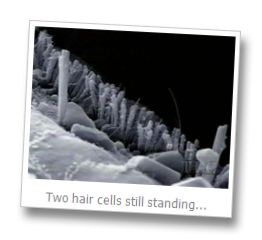
1k hz Technically I have a profound hearing loss. I’m almost as deaf “as a doorknob” as Abbie so nicely put it. A few remaining hair cells in lower frequencies up to around 1000 Hz (1 kHz) is all I have in my residual hearing. I have explained “recruitment” before, and that is still a big issue. Consequently I suffer from hyperacusia, which gives med a kind of head-ache within seconds. It feels like being struck hard on both sides of my head (by the ears) at the same time with something physical (as in blunt violence). The pain then seems to go through my head from ear to ear, kind of pulsating into the brain.
Sources that are prone to give me these hyperacusia-attacks is: my son when he forget himself and shouts/screams, the refrigerators compressor when I stand close to it, cars and traffic, multiple sources of sound (especially when trying hard to comprehend speech, the sounds coming from my computer (not sure if it’s vibration sound from hard drives or the chassis fans. The list of troubling sounds go on and on.

Secondary sensory disturbances are making themselves more and more noticeably.

Feeling of vertigo is increasing, and from time to time I experience trouble with my balance. I almost trip and have to make corrective steps quickly in order to prevent myself falling to the ground. Especially when visual context changes quickly, like first looking up at trees and the sky and then looking down on the ground. Or if I walk down a corridor, and stairs appear right around a corner… The sudden visual change from flat floor to stairs going down is becoming a challenge. Railing next to the stairs are a good thing for me now. This is a problem going down. Not so much while going up the stairs.

Wendy_Painter_Migraine_1993small_en

Photophobia is more acute than ever. White clouds are the worst weather condition for me. I can have trouble driving when the sky is white with bright illuminating clouds. Under such conditions, my eyes feel sore and I squint as much as possible, and sometimes the eyes get filled with tears. Sunshine doesn’t bother me much as I can avoid the direct source. An entire sky with bright white clouds are a little more difficult to shield from.  Thank heavens for sunglasses.
I also experience dry eyes after a day with a lot of light. My nice cozy 24″ computer flat screen can illuminate quite well, to the point of discomfort. Good thing all this is adjustable. I use a lot of dark colors on software’s skins, on desktop and so on. Also I have adjusted the panel itself to lower brightness. Let’s just say that at times I blink a lot, and I do take breaks.

Audio depth perception (and pitch)

Thanks to all friends who responded about my question of wether to fight for bilateral from the start-line or do one by one

The decision has now been made :-) I want stereo!!! I want depth perception and I want my pitch back….

Kitaoka-OutOfFocus333

This image is a good analogy of the sound-problem I have these days. Try to focus on this image for an hour or so, and then you can slightly imagine what it is like for me to concentrate on speech that is “out of focus” for my brain…

Also thanks to Michael Chorost for his (previous posts and) article in “The Journal of Life Sciences”: “Living in stereo” on the subject.

Since I’m already on the path of thanking people, I’d like to include Amy Shah for writing an article about the importance of pitch in speech comprehension: Pitch Perception and Cochlear Implants. This article illuminated a black hole in my understanding of what is happening to my sense of hearing… (My question was: I can still hear somewhat, but why has it become so difficult to understand speech? Her article explained that to me…)

Try this for testing your Pitch perception ability…

It’s all about perception…

motion_sm

My un-sound condition – pre CI era

I want to make this list in order to remind myself what it was like before I got the CI (2007/2008). Maybe I run into problems post-surgery post-sound activation and need a reminder of how I reacted to sounds before the operation(s). It’s a time capsule to myself…

Here’s a similar post I wrote January this year…

These are the sounds that causes great stress, fatigue, even pain and vertigo in me these days… 
  • All things mechanical like car engines, especially bigger engines like on buses and trucks.
  • to many voices at the same time, especially if a little loud
  • the clanking sound of ceramics against ceramics (dinner plates)
  • my son at the top of his voice (vertigo)
  • my mothers voice when louder
  • children voices
  • the vibration sounds from my computer, or maybe it’s one of the fans
  • inside my car
  • elevator music and “muzak” (because it’s too faint for me to grasp, or too noisy otherwise, my brain tries too hard)
  • the hiss from the steamer on a cappuccino-machine
  • if everything else is quiet, the refrigerator noise is picked up by my HA and that sound wears me down
  • the air-condition in office buildings and alike
  • stiletto-heels and other hard shoe soles on hard surfaces
  • vacuum-cleaner and other domestic appliances
  • music     :-(
  • any sounds in a room with bad acoustics (naked floors, walls and ceiling echoing sounds)
  • any background sound when I’m having a conversation
These are the sounds I can’t hear at all anymore even with hearing aids on
  • Birds singing (could hear them faintly as a kid)
  • My cat meowing
  • My bedside alarm clock
  • the fire alarm
  • the doorbell
  • running water
  • rain falling on rooftop
  • someone yelling my name from a distance or another room

My hearing diagrams

Finally got myself around to scan these charts and post them here :-D

First of all, here is a source of terminology and technical explanations related to sound.

From 2004:

hearing diagram 2004_fixed

The yellow “banana” is the speech discrimation area for normal hearing. Deafness is defined as below 85 dB. The measurement stops at 100 dB. On this measurement I was intent on doing the best I could, so I probably cheated by looking at signs in the face of the lady doing the test, through the looking glass from the booth I sat in…. Another problem is phantom sounds or echoes that appear from the test itself. Did I hear it or not? Was it a phantom sound or a real test sound? I have taken this test so many times that I quickly get the rythm of sounds from the audiologist and know when the sounds go up and down… I know their testing regime instinctively… Sad thing it only hurt myself when I cheated on the tests, the hearing aids were adjusted based on these results…

From 2006, 2 years later:


hearing diagram 2006_fixed

A noticeable drop in the 125 to 500 Hz-area (the deepest bass sound frequencies). This is the last test I took before commencing the long road to a CI in Norway. There is no doubt, the hearing is declining and I am clinically deaf, and have been for some time….

I also took a speech comprehension test (bottom chart on the 2006 diagram) and I think I scored 0%… What I heard I could only take a wild guess on….

What’s next?

Not before long I will post an abridged translation of a letter that I have sent to the Norwegian Treasury Department (Finansdepartementet). This is something I have been working on for some time now, in the wake of the budget cuts at the premier hospital i Norway; Rikshospitalet (ref. last postings regarding my interview on national tv etc). This work was also the reason why I needed “time” off from my blog (good thing the Easter came in the middle of this). Stay tuned friends!

Status update II

Where to begin??? Well, since my last “Status update from Nov. 6th 2007” (where everything is still valid, I won’t repeat everything) some things has changed.

Overall everything is a little bit worse. Tinnitus is loud, perhaps more constant, fatigue is a bit more severe. I get tired a lot faster from a lot less sound. Headaches are frequent.
It’s gotten to the point where I can’t stand the sound of pretty much anything. Even faint fan-noise is uncomfortable. I’m pretty much intolerable to any sound now.
Less than a year ago I was able to listen to music, now I have my hearing aids turned off more than they are on… I rely more and more on my lip-reading skills…
Bilateral CI-operation is still my number one priority. Other than that I continue to take care of my 7 year old son, my fantastic girlfriend (so grateful to have you in my life, honey!!!), family and myself as best as I can. My psychologist has helped me to be able to be comfortable with the fact that there’s not much more I can do. So instead of feeling lost in a black hole, filled with despair, I relax as much as I can, think positive as much as I can and so on. But I have to admit that some times I get the blues and wished that CI-operation could be in the past instead of in the future. But then again, that’s something to look forward to, right?

I am now at about number 60 on the waiting-list for the CI-screening. About 4 months ago I was at the 100th place. If that pace holds, it means about 10 patients a month, which means I could be looking for an appointment at around 6 months from now… Say august… I certainly hope so!!! I really shouldn’t complain, because I’m a lucky guy, really, who live in Norway and these kind of operations are funded by our health-care system… But things can always be better! If not for me, than maybe for the future post-linguistic-deaf person who need CI…

It will be interesting to see how the hospital will respond to my request for doing both ears simultaneously…. It’s not at all standard procedure, I know. It’s just that there’s really no alternative for me, so I might as well get both ears done at the same time…

I think the technology is ripe (Advanced Bionics Harmony with HiRes90K implants that can do 120 frequency bands), the surgery-techniques have developed and are pretty secure. Besides, operating one ear at a time is less cost-efficient than doing both at the same time. 300 000 NOK for one, and 500 000 NOK for two. That’s a whopping 20% saving! Or 100 000 NOK in plain numbers. Not to mention, my recovery will be over once and for all, and I can get back to the workforce sooner.

If the surgeries are done one at a time, I guess it will be almost 3 more years before I’ll get through it for good. In total that could be 6 years (!) of my life dominated by this CI-process…

ASCII-Man1 The long walk…

If I also take into consideration the time I spent dealing with the fact that I slowly lost my hearing, I would have to add a few years to those 6 waiting for CI. I also struggled with work since 2002. I’m up to almost 10 years of my life!!! If everything had been optimized, it could have been as short as 2 maybe 3 years….  Something could have been done a lot better by the health-care system and by the governments…

I hope that I will be able to work and function even with one CI, but I know it will take more strain on me. I know how it is to be deaf on one ear, too (all those times with defect HA, no good battery etc. etc.). And remember, CI is not fixing my hearing to a 100%, but maybe 30% of perfect hearing. Those 30% is certainly a lot more than the 0,5% I have now…. In fact, it’s more than I ever had. All my life I had approximately 20% residue hearing… And if I get more sound from all over the frequency-chart, I will be a very happy normally functioning deaf man! :-)

Other than my deafening, my knees are shot, I’m still waiting to hear from the hospital after the initial response that my request has been recorded and acknowledged… I’m not able to do any physically challenging things like running (forget it), ice or in-line skating, swimming(!) or long walks…  I’ve been gaining kilos all throughout this winter :-)   More of me to love ;-)

Last night I finally got through the sleep-registration for detecting if I’m suffering from sleep apnea or just plain snoring… Something I decided needed to be ruled out as cause or bi-factor of my relentless fatigue…. Report is due in the mail sometime soon…

I have to thank all my blog-friends here: Thank you for sharing your experiences with the world, thank you for reading my blog and for encouraging words and support! I salute you all! You are indeed a well of good information!

Beautiful Butterfly Jen, Bionic Woman Abby, Running Crazy Sam, Michael is writing Chorost, Metal in his head Jeff, Great Cochlear Kids, Roberta from Italy (where’s your blog?) and many more!

Unconditional condition

I just sat very comfortably in my favorite chair in front of my computer for two hours, doing some work that requires concentration. I had no sounds to distract me, since I turned my hearing aids off for the work-session.
I can’t stand the sound of the fans, even though I have water-cooled most of my rig, the hard-drives give off too much heat for the whole thing to be able to run without fans… I think the sound can’t be much more than 17 – 20 dB (according to fan specifications), and that’s a faint sound, really. But my hearing aids are the most powerful there is (to my knowledge) and they’re cranked to the max. (Widex Senso Diva). So I turn them off more and more these days…

The recruitment is killing me if I don’t turn them off.

The tinnitus is there as always, but not really bothering me concentration-vise. It’s sort of comforting, since the sound now has a rather steady tone. (before it was a chaos of frequencies and variations in strength/volume)
Anyway, I sit, my head is not moving, my eyes are only fixated on the screen, and my concentration goes to the task at hand. The first hour goes fine, no problems.
The second hour I start to get physical sensations in my head. It is like pressure building slowly up.
I had a good night and I’m not tired. I have no stress to complete the work I do, and have no deadlines for anything. It’s Sunday :-)

radThen suddenly I get these auditory sensations, it’s like a silent storm. I can feel it somehow. Not like pain, it is not unpleasant, it’s just a sensation of very weak electric current in my brain. Like a blanket of electricity sliding back and forth like the radar screen image.  It’s like a soft “wooosh” inside my brain…
The sensation that I have are connected to my ears, and at the same time they affect all of my brain (at least it feels like it does). I have no control of this sensation.

I wrote about this sensation before, connected to a pre-sleep phenomenon. This is very much the same, only now I get it during daytime too…

Seconds after this “wooosh”-sensation I feel dizzy (I guess there’s some kind of activity affecting my Vestibule where the balance-nerves are situated). It’s a weak vertigo, even though I sit still, are at peace with no stress. And I know I don’t have Meniére, thank goodness…

After this my ability to concentrate is worse. It’s difficult to keep a thought for as long as I like. My mind has always been a multitasking one; while doing one thing, my mind has been working out what the next thing I should/want to do… This is impossible in the state I’m in after only two hours of working effortlessly… It’s frustrating for me, because if I’m doing something that gives me a thought that I want to pursue, the short-term memory isn’t working as I’m used to. So when I complete the task I worked on, I KNOW that there was something I thought of doing, like searching for a special kind of information, or look up a certain fact etc. etc. But it’s gone… Sometimes I sit for 10 minutes of more, pondering what it was that ignited that thought, trying to reconstruct the idea for myself… Sometimes I get it, most often I just move on… I can’t let it get to me.

In short it makes me feel like I’m cognitively amputated… The SUDOKU-thing helped me understand this better…

And by writing this now, and concentrating on the subject and all the aspects of writing, I feel I’m pushing myself… I’m starting to get a headache now… This is the part I do not understand at all…

I haven’t heard a sound all morning (it’s now 12.30, I started working at 9.30). I know my hearing is disappearing, and the tinnitus is singing it’s tune. But why is it a strain for me to do something that doesn’t affect my hearing? Why do I get this dizzy feel, why the headache, why the memory-problems, why the multitasking problem, why the feeling of fatigue? Can it be that the optical-nerve also lies close the the nerves of the auditory nerve and the balance-nerve? It is all connected somehow…

My jaws feel like they had a punch (they’re sore, like I chewed gum for a few hours). My temples hurt a little bit. The dizzy feeling is there (but I’m not having trouble with the balance, though).

This state/condition will last all day, until late at night, then I feel better again, but the paradox then is that I need to sleep. I might me tired, but want to stay up because the world feel somewhat more vivid to me. Is it connected to me originally being a B-person? I’m not extreme, have no troubles getting up in the morning whenever… (but used to)

Captioning videos @ Overstream.net!

One of my CI-blogfriends, Abbie (Chronicles of a bionic woman), recently created this captioned CI-activation-video! For all of us who can’t understand spoken words very well, this is a gift!
Thank you Abbie, for letting us really participate in your experience. I learned a lot just from understanding what your audie says!!!

I saw this video uncaptioned, and didn’t get much from it, but that changed with the captioning!!!
For all of you who can hear, watch this, and remember that the ear Abbie is hearing on this video used to be deaf!!

I’d also like to give attention to the online-site that make captioning possible:

Overstream.net KUDOS!!!!

All you videobloggers and video-posting maniacs out there: please caption your videos if there are dialogue or even sign-language!
Make the world a richer place for all those who cannot hear well (or read sign-language)!

Vestibular disorder symptoms I have experienced

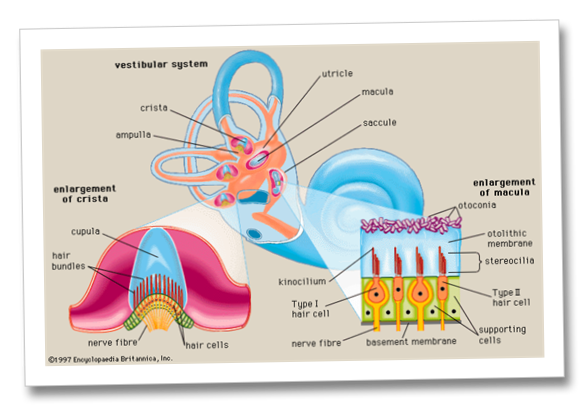
I came across an interesting website for an organization called VEDA (VEstibular Disorder Association).  I found this list of possible symptoms that is very interesting.

Image copied from “vestibular system.” Online Art. Encyclopædia Britannica Online. 23 Jan. 2008
Here is an explanation of the Vestibular system.

I did not initially place all these symptoms into the same category (i.e. having to do with my hearing), but maybe I should have??? I exctracted the whole list and will excempt (a strikethrough line) those not experienced by me. If commented, the comment has been marked like this.

This list was a revelation to me… It all fits, kind of… Seems it connects to the wiring of the vestibulo-cochlear nerve: the nerve that carries information from the inner ear to the brain. Also called the eighth cranial nerve, auditory nerve, or acoustic nerve. If the “recruitment”-theory in my previous article holds water, the information about these symptoms could also have some bearing on the subject of my condition.

Vision

  • Trouble focusing or tracking objects with the eyes; objects or words on a page seem to jump, bounce, float, or blur or may appear doubled
  • Discomfort from busy visual environments such as traffic, crowds, stores, and patterns.
  • Sensitivity to light, glare, and moving or flickering lights; fluorescent lights may be especially troublesome Very much so!
  • Tendency to focus on nearby objects; increased discomfort when focusing at a distance
  • Increased night blindness; difficulty walking in the dark Yes, have to find walls or points of support in order to be able to move, get a complete feeling of immediate disorientation
  • Poor depth perception

Hearing

  • Hearing loss; distorted or fluctuating hearing Well, that’s not exactly news…
  • Tinnitus (ringing, roaring, buzzing, whooshing, or other noises in the ear) Very much so!
  • Sensitivity to loud noises or environments Especially high pitch like childrens voices
  • Sudden loud sounds may increase symptoms of vertigo, dizziness, or imbalance Yes!


Read the rest of this entry »

Explaining the analogy: "Recruitment" of hair cells in cochlea

During my research into my own declining hearing- and health condition, I came across information about a phenomenon regarding hair cells in cochlea called “recruitment”. I strongly suspect “recruitment” is what happens to me. It certainly would explain a lot of the things that happen(ed) to me and my hearing and the fatigue…

(Most of the text that follows is copied from this page at hearinglosshelp.com and edited by myself for the sake of this blog and my readers.)

What is “Recruitment”?

Very simply, “recruitment” is when we perceive sounds as getting too loud too fast. How is it possible to hear too loud when the hearing in fact is vanishing, you may ask… Well, be patient with me and read on…

“Recruitment” is always a by-product of a sensorineural hearing loss. If you do not have a sensorineural hearing loss, you cannot have “recruitment”. In simple layterm this means that this condition only affects those who have a significant loss of hearing caused by haircell-damage in cochlea (mainly).

As a sidenote; there are two other phenomena that often get confused with “recruitment”. These are hyperacusis (super-sensitivity to normal sounds) and phonophobia (fear of normal sounds resulting in super-sensitivity to them). Both hyperacusis and phonophobia can occur whether you have normal hearing or are hard of hearing.

An analogy for understanding how “Recruitment” got its name

Perhaps the easiest way to understand “recruitment” is to make an analogy between the keys on a piano and the hair cells in a cochlea.

The piano keyboard contains a number of white keys while our inner ears contain thousands of “hair cells.” Think of each hair cell as being analogous to a white key on the piano.

The piano keyboard is divided into several octaves. Each octave contains 8 white keys. Similarly, the hair cells in our inner ears are thought to be divided into a number of “critical bands” with each critical band having a given number of hair cells. Each critical band is thus analogous to an octave on the piano.

Just as every key on the piano belongs to one octave or another, so also, each hair cell belongs to a critical band.

The requirements for “Recruitment” 

When you play a chord on the piano—you press two or more keys together but they send one sound signal to your brain. Similarly, when any hair cell in a given critical band is stimulated, that entire critical band sends a signal to our brains which we “hear” as one unit of sound at the frequency that critical band is sensitive to. This is the situation when a person has normal hearing.

However, when we have a sensorineural hearing loss, some of the hair cells die or cease to function. When this happens, each “critical band” no longer has a full complement of hair cells. This would be analogous to a piano with some of the white keys yanked out. The result would be that some octaves wouldn’t have 8 keys any more.

Our brains don’t like this condition at all. They require each critical band to have a full complement of hair cells. Therefore, just as any government agency, when it runs short of personnel, puts on a recruitment drive, so too, our brains do the same thing. But since all the hair cells are already in service, there are no spares to recruit.

Getting to the point – what “Recruitment” means

What our brains do is rather ingenious. They simply recruit some hair cells from adjacent critical bands. (Here is that word: recruit or recruitment.) These hair cells now have to do double duty or worse. They are still members of their original critical band and now are also members of one or more additional critical bands.

With only a relatively few hair cells dead, then adjacent hair cells may just do double duty. However, if many hair cells die any given hair cell may be recruited into several different critical bands, in order to have a full complement of hair cells in each critical band.


The results of the phenomenon known as “Recruitment” – the conclusion

The results of this “recruitment” gives us two basic problems. (notice the underlined parts!)

  1. The sounds reaching our brains appear to be much louder that normal. This is because the recruited hair cells still function in their original critical bands and also in the adjacent one(s) they have been “recruited” into.

    Remember that when any hair cell in a critical band is stimulated, the whole critical band sends a signal to our brains. So the original critical band sends one unit of sound to our brain, and at the same time, since the same hair cell is now “recruited” to an adjacent critical band, it stimulates that critical band also. Thus, another unit of sound is sent to our brains. Hence, we perceive the sound as twice as loud as normal.

    If our hearing loss is severe, a given hair cell may be “recruited” into several critical bands at the same time. Thus our ears could be sending, for example, eight units of sound to our brains and we now perceive that sound as eight times louder than normal. You can readily see how sounds can get painfully loud very fast! This is when we complain of our “recruitment”.

    In fact, if you have severe “recruitment”, when a sound becomes loud enough for you to hear, it is already too loud for you to stand.

  2. The second result of “recruitment” is “fuzzy” hearing. Since each critical band sends one signal at the frequency of that spesific critical band, when hair cells get recruited into adjacent bands, they stimulate each critical band they are a member of to send their signals also. Consequently, instead of hearing just one frequency for a given syllable of sound, for example, perhaps our brains now receive eight signals at the same time—each one at a different frequency.

    The result is that we now often cannot distinguish similar sounding words from each other. They all sound about the same to us. We are not sure if the person said the word “run” or was it “dumb,” or “thumb,” or “done,” or “sun,” or? In other words, we have problems with discrimination as well as with volume. If our “recruitment” is bad, our discrimination scores likely will go way down.

    When this happens, basically all we hear is either silence, often mixed with tinnitus or loud noise with little intelligence in it. Speech, when it is loud enough for us to even hear it, becomes just so much meaningless noise.

    This is why many people with severe recruitment cannot successfully wear hearing aids. Their hearing aids make all sounds too loud—so that they hurt. Also, hearing aids cannot correct the results of our poor discrimination. We still “hear” meaningless gibberish.

    However, people with lesser recruitment problems will find much help from properly adjusted hearing aids. Most modern hearing aids have some sort of “compression” circuits in them. When the compression is adjusted properly for our ears, these hearing aids can do a remarkable job of compensating for our recruitment problems.

Sudoku vs. cognition

What in the world could the term Cognition have to do with Sudoku? Well, let me explain…

For a Sudoku to be solved, you need to be able to learn, reason and remember numbers. Most of which has to do with the term “cognition” (click the word above for a precise terminology).

I learned about my own cognitive condition from doing a lot of Sudoku the past years. For instance I learned that having poor sleeping over longer periods made my Sudoku solving ability very poor. Also if I was plainly tired from a long day, my Sudoku skills suffered. Other things that made Sudoku hard for me to solve was the (for the time being) ever present fatigue, tinnitus and level of blood sugar.

After I became quite skilled in Sudoku, I recognized variations in my own mental performance. And soon it became apparent to me that my mental performance also followed certain patterns. And this is the interesting part that made me want to share this with my readers.

Sudoku taught me when I was tired in a time where I was always tired, if that makes sense??? It’s the fatigue-thing I’m talking about… How did THAT help me? Well, there was variations of tiredness over time. Some days I just couldn’t remember from 5 minutes earlier, or I had trouble concentrating on the task at hand (I have a special routine for solving them). And since I was all about getting better, noticing the good or bad days for Sudoku gave me an external method of measurement of my mental state in a period where my own built-in sensor needed calibration, so to speak :-)

Sudoku taught me how to trust and USE my own sense of tiredness again. The feeling of tiredness is a signal to ourselves to slow down, to take a break, to eat and drink, to sleep or take a nap and so on…

Yes, I was truly f***ed up, I had lost the ability to heed the signals my own body and mind gave me… Sudoku helped me almost in a scientific way to regain that.

I continue to do Sudoku, allthough not as much as I used to, but it is still a fine tool for measuring my own cognitive skills. And I can recommend Sudoku to everyone as mental training. It has been and continues to be useful to me, not only as a tool for mental measurement but also as hobby that trains my cognitive skills somewhat… And we all could do with better brains, right?

Dreams with captioning?

Ever imagined getting captioning in your dreams? I received a question from one reader yesterday that made me analyze my way of dreaming.

The question was wether I hear sounds in my dreams or not, being almost deaf and having lived with hearing aids since the age of 4. As opposed to people who has been deaf all their lives, and report that their dreams has no sounds.

I couldn’t answer the question inpromptu, since said questioneer never left any contact-information, but hey, it’s an interesting issue and since I had a very vivid dream last night, I might as well make a little post of it :-)

am_rapide_hi_30 The dream last night involved high speed car driving, a big explosion, some nature and various scenery (sort of like an industrial site, maybe an open mine). I can definitely say that I dream in colour! The car was a black Aston Martin Rapide, the grass was vividly green, the tarmac was black with white and yellow stripes on it and fences had a colour of metal (among other things).

As for sounds, most of the action was without sounds (no engine sounds, no screeching tires etc), but I dreamt that the car had a 26″ grenade shell (!) with it (plus a smaller one, for some reason). It was the kind of grenade that is loaded into huge cannons and it was compromising evidence that needed to disappear after a traffic incidence (because of the wild driving, I guess). So the car (with my son in it, for some reason) sped away from me after it had rolled sideways down a grass-slope. The driver needed to find a remote area where the grenade could be detonated and hence be disposed of…  (I know, it was a wild dream!!! :-) hehe )explosion-l

And this is where I get to wether I dream in audio or not. I dream in audio a little bit, because I remember that I heard the explosion (I did not see it), and started to run towards the origin of the sound.

So there you have it! Mostly I dream in facial-expressions, peoples actions, my actions (like running, trying to run, flying or trying to fly etc) and with colours. Not so much with sounds, although sometimes, and almost never (afaik) in actual conversations. I guess I’m a very “visual” kind of dreamer….

And no, I do not have dreams with subtitles, allthough that would be nice ;-)

Mentally drowned

Feeling of defeat is not a good feeling. Yesterday I attended my fathers 60th anniversary celebration and had some experiences with my hearing, or rather, the lack of hearing…

In the days up to his celebration yesterday, I had my son with me as I usually have every second (extended) weekend. This time I really had my hands full just dealing with my son. Not that he is raucous or anything. But my strengths go only to a certain level these days as demonstrated yesterday. I was supposed to bake a cake to the celebration, which I had voluntarily said I would bake. And I really wanted to do it, too. But the thing with my memory when fatigue hits is that it’s very similar to what happens when one has depression; performance is poor…

Luckily one of my brothers has gotten a knack for baking himself lately (as he is expecting his firstborn I guess his domestic consciousness arises ;-)   ) and the cake supply was sufficient.

Family members who hasn’t seen each others for a few years have a lot of catching up to do. Usually I try to arrive a little early, in order to be able to have a few words with whomever gets in before there’s too many. This time the weather was bad with blizzard so the drive took it’s time…Cornered_20Kitten

I sat down in the couch in the corner (always try to avoid getting any sounds behind me) and could not distinguish anything that was being said around the table.

Being happy to see relatives, wondering what had happened in their lives lately, I guess I tried too hard in the beginning. I quickly got tired from trying to follow conversations.

My blessed super girlfriend sees right through me, and could tell how tired I became just by looking at me. She made me aware to take a rest by turning my hearing aids off. But in a situation like that it’s nearly impossible to be able to rest, because my eyes do most of the work. I scan the room to see if anybody has their eyes directed on me, if they are talking to me. And every now and then someone does talk to me, and I turn on my HA and lean forward to try to decipher what they ask me…

After a few hours I was shot… Simply shot….  No strength left, and I was on my “emergency battery”. I told everyone that I had to leave because I didn’t feel good, and I gave them a quick explanation. I’m lucky to have a understanding family.

But the feeling of defeat was quite heavy. I felt forced to withdraw before I wanted to. I hated it. But it was necessary…

Yesterday it was clearer than I ever have experienced… It is very difficult to describe the state of my condition then, but I’ll give it a try:

If you take a whole pack of chewing gum and chew on it a whole day you know you are bound to have an aching jaw, ok? This was quite a similar sensation: the side of my head felt like it had been pounded by someone with boxing gloves for a few hours. Headaches (on the sides, around my temples), a sensation of dizziness and all sounds was kind of like painful. The sounds were unpleasant and felt intruding and annoying.

Today, as I write this, my head still has this ring in it. I write this now even before I have gotten out of my bed, because I know that not before long, I will be mentally too tired to conjure any text like I want to…drown2

It’s a hellish place to be… Like being forcefully drowned mentally. And because the transition to deafness is so slow for me, I have fallen in some kind of trap, by not being able to protect (get CI) myself in time.

But here I am, and I have to take care of my son, myself, and keep on with my life. I know there is a solution for me up ahead with the CI, and it can’t come soon enough!!!

I have high hopes for 2008 to be the year when I either get word of when my first CI will be inserted…

I need it badly, as confirmed yesterday….

The sum of 2007 – Happy New Year!

As 2007 soon is history, I feel it is appropriate for me to sum it all up for myself.

Even though my hearing is coming to an end, there are, however, sounds to look forward to. And that is the CI-sound! Still have to wait for it, but in the meantime, I can take care of myself and prepare myself as best as I can.

The year 2007 gave me many good things:

  • I started really believing in a better life for myself.
  • I learned A LOT about myself and life in general.
  • I’m much more self-confident in my role as a father to my beloved son.  
  • I consolidated my relationship to my great, great super girlfriend. Thanks for being in my life, honey!!!
  • I had the opportunity to spend time with my girlfriend ;-)
  • I learned a lot more about CI, and I’m even more certain that it is what I need.
  • My health improved a lot from reduced stress.
  • I did a fair share of traveling and had a lot of activities. I’ve been busy, all right :-)
  • This blog has become a good thing for me, I also made new online-friends from it :-)
  • I discovered that my knee(s) probably need surgery so I can exercise again. (too much pain lately). It’s a good time to fix such stuff now, as I’m waiting for CI anyway :-) Just hope I don’t have to wait too long for the knees to be fixed either…
  • I made a lot of new acquaintances in the CI-community, for which I am grateful…
  • My life seems to fall into place now, as opposed to a little more than one year ago, where I felt everything fell apart…
  • Took care of my eyesight (new lenses and new glasses)
  • Relationship with family improved overall.
  • I learned to cope with my tinnitus, it’s almost soothing sometimes
  • I’m reading books on a steady basis again! For many years I have been so tired/fatigued that my ability to concentrate was very poor. I used to be an avid reader of everything, and now I’m on my way back :-)
  • I’m sleeping well again.

The year 2007 gave me a few downturns too:

  • CI surgery is still in the blue as for a fixed date
  • The music’s over for now. I get no more pleasure from it (only occasional glimpses), only more fatigue and “head/earaches” :-(  
  • Speaking of fatigue; my battery is still worn these days, it takes long time to charge and very short time to empty… But it has improved a little, and that is to me good news, really! I feel the tide turned in 2007.
  • Trouble walking stairs both up and down, thus disabling me to exercise rigorously, which was supposed to have been my project number one this year (in preparation to CI-surgery). Even swimming was painful… Will be fixed soon I hope…
  • The tinnitus became a factor that I had to deal with. It is slowly increasing in force (louder and louder), but luckily it’s a steady tone, rather than the chaotic concert it was at first…. It’s more prone to appear when I’m tired, so it’s a signal for me too, to slow down or turn off my hearing aids for a break…

All in all, 2007 was a good year for me. Happy New Year, everyone!!!

Making sense of the world through a cochlear implant

PET20YEAROLD_HIGH March 13, 2007 -  Scientists at University College London and Imperial College London have shown how the brain makes sense of speech in a noisy environment, such as a pub or in a crowd. The research suggests that various regions of the brain work together to make sense of what it hears, but that when the speech is completely incomprehensible, the brain appears to give up trying.

The study was intended to simulate the everyday experience of people who rely on cochlear implants, a surgically-implanted electronic device that can help provide a sense of sound to a person who is profoundly deaf or who has severe hearing problems.

Using MRI scans of the brain, the researchers identified the importance of one particular region, the angular gyrus, in decoding distorted sentences. The findings are published in the Journal of Neuroscience.

In an ordinary setting, where background noise is minimal and a person’s speech is clear, it is mainly the left and right temporal lobes that are involved in interpreting speech. However, the researchers have found that when hearing is impaired by background noise, other regions of the brain are engaged, such as the angular gyrus, the area of the brain also responsible for verbal working memory – but only when the sentence is predictable.

“In a noisy environment, when we hear speech that appears to be predictable, it seems that more regions of the brain are engaged,” explains Dr Jonas Obleser, who did the research whilst based at the Institute of Cognitive Neuroscience (ICN), UCL. “We believe this is because the brain stores the sentence in short-term memory. Here it juggles the different interpretations of what it has heard until the result fits in with the context of the conversation.”

brainxrayThe researchers hope that by understanding how the brain interprets distorted speech, they will be able to improve the experience of people with cochlear implants, which can distort speech and have a high homer-simpson-wallpaper-brain-1024level of background noise.

“The idea behind the study was to simulate the experience of having a cochlear implant, where speech can sound like a very distorted, harsh whisper,” says Professor Sophie Scott, a Wellcome Trust Senior Research Fellow at the ICN. “Further down the line, we hope to study variation in the hearing of people with implants – why is it that some people do better at understanding speech than others. We hope that this will help inform speech and hearing therapy in the future.” 

Cold on cold winters day

Still suffering from that common cold I reported on a few days back, I feel it takes forever to recover. I’m an impatient guy who hates to be slowed down. But I guess the years have given me at least a little more of that precious patience. When I grew up i was prone to get ear-infections and had more than my fair share of common cold and alike.
This time it has been a while since last round so I notice things more vividly. I am even more baffled by the impact the clogged sinuses and all other symptoms have on my hearing. Talking in a controlled environment is harder, thus giving me even more strain by communicating. Being in noisy environment communicating is virtually impossible.

I have become quite obsessed these last years about dressing myself properly to avoid getting cooled down and thus more vulnerable to catch a cold os something similar. I make sure to stay warm on feet, head and neck as good as I can. I can sense when I get bugs in my body, and mostly I feel I’m able to beat it down before I get sick. It takes a few hours sleep and a lot of heated beverage like milk with honey in it :-)

Sometimes I wonder if I’m developing paranoia for illness, or if I’m a hypochondric…

Speaking of hypochondria, I remember when I was young I was often accused of being hypochondric, because I complained a lot. In retrospect I can understand that, and at the same time, I understand my own behaviour. What I didn’t understand was how I was affected when I had a cold. And being young and utterly impatient the feeling of increased isolation and deafness wasn’t easy to deal with.
Over the years I have slowly come to terms with all the issues concerning my state of hearing, and I have also developed this “smartness” in avoiding getting sick. I’m quicker to sense when the air is getting colder on the evening in the late summertime/beginning of fall. I know my own body better and treat it with more respect than ever before.

ist2_2899227_welness_massage_stonesI do exercises on a daily basis to prevent back and neck-pains. I have gone a few rounds with my physician, and have been able to determine that my right knee has a injury to it that needs closer attention. I guess I’m simply more bodily aware than ever before, and that is a good thing, because I need to optimize (compensate) for the secondary impacts of my near deafness on my body.

For example, my back pains originate in the fact that I use my neck to protrude my head when I have trouble hearing (you know; putting my ear out to signal that I do not hear properrly). Over the years that have resulted in a neck that does not harmonize, thus straining my back further down, causing secondary symptoms.

A course with a psychomotoric therapist and advices from my girlfriend has taught me this.

The exercises I do now really feel beneficial to me. Amount of back pain is reduced to almost nothing. Headaches caused by stiff neck and stress is reduced. All because I won’t stop trying to figure things out….

Link to Spine-Health, about common cold and hypochondria

In sickness and health

Coming from a lot of resting and relatively no stress I can feel somewhat energized. But the feeling of fatigue is less than one hour away still, and that can be frustrating. But I have come to terms with the fact that this is how it is – for now anyway. And I feel that I’m getting better a little at a time. I hope it’s not just wish-thinking…..

Yesterday I came down with a regular cold. Comes with the season, and especially when you have kids roaming in germ factories like schools.

All hearing aid users probably know this: being hard of hearing makes you a extra deaf when being “stuffed” and having to blow your nose every ten minutes or so… But for people who do not know how it is to be hard of hearing and use hearing aids, it’s virtually impossible to understand the impact of a common cold on hearing aids users. This is what I want to try and explain now.

When common cold occurs, one is likely to get an increase in internal pressure in the neck/throat region due to various swollen glands. This in turn puts pressure on internal organs in the head, hence headaches, light-sensitivity and REDUCED HEARING. When the cochlear has more internal fatigue-736871pressure where the hair-cells are situated, the gel-substance that carries the sound waves to the hair-cells is a little less sensitive. That means that the overall amount of energy that reaches the hair-cells in cochlear is being reduced.

Then there’s also the impact of all the fluids that forms in the sinuses.
With reduced hearing in the first place, such an reduction on the hearing gives a larger effect on hard of hearing, thus making us more deaf.

Aside from the normal symptoms of common cold that makes you tired, feverish and so on, it also makes near deaf’s have to put even more energy into the business of communicating.

I propose that near deaf need an extra low threshold for sickness leave from work etc. It is also important that the employer understand the fact that common cold has a stronger impact of people with hearing disability.

Technorati Tags: ,,,,,,,

Dreaming deafness

Woke up early today from a vivid dream…Behind Closed Eyelids

I was at a banquet or an award show or like, and the hostess and host of the show somehow pointed me out among a lot of people and started making their way towards me.
That would normally be the last thing I would wish for, as I have had a lifelong fear of appearing stupid in case I answered wrong. (you know, if I didn’t hear the question properly, I would answer something else, thus making it funny for everyone…)
With microphones jammed up in my face and spotlight zooming in on me along all the attention from everyone present, they started asking me easy questions I was able to answer ok, you know, to warm me up… 
Then the guy came “to the point” and halfway into his question I lost him completely. That would be where I normally wanted to sink into the ground and die of shame or embarrassment. In this dream I just said: “I’m sorry, I didn’t hear you.” Being very calm inside, laid back and not stressed, I waited for their next move. Somehow the social pressure on me was gone, because they had a show to pull off, and by picking me the “joke” was on them. I could see the guy lost his nerves and didn’t know what to do. At such instances I feel terribly sorry for the person, and want to help, but in this situation they were interviewing me, and I could not help by taking charge of the conversation as I normally would.
The woman stepped in for a try and she failed too…. then I woke up, wide awake…

This was a weird good dream for me. Can’t remember last time I had a dream about being out there publicly. And the thing that hits me about this dream is that I’m just being me and honest about it (that I can’t hear everything), unlike before in my life, where I’d have a number of strategies for “handling” such a situation, thus “saving face”. Doesn’t matter what kind of situation I’m in, I’m who I am… Near deaf and all :-)

I think this dream was some kind of milestone for me.